
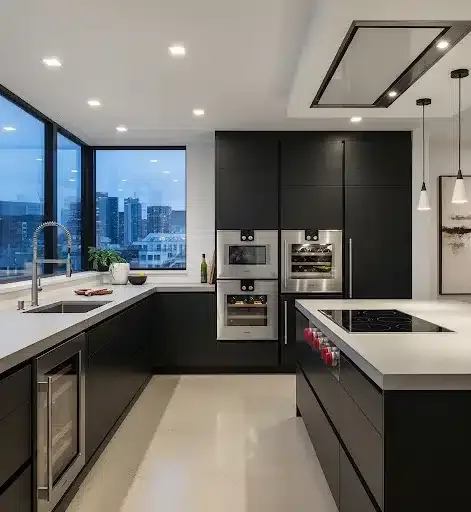
How to Design a Small Modular Kitchen design: Space-Saving Solutions & Cost Insights
Designing a small modular kitchen design doesn’t mean compromising on style or functionality. With the right approach, you can create a space that is both aesthetically pleasing and highly efficient without breaking the bank. Whether you are planning a kitchen renovation or a complete kitchen remodel, focusing on layout, materials, and storage solutions will ensure that your compact kitchen works perfectly for your needs. In this guide, we’ll walk you through expert tips, budget-friendly options, and modern design ideas to help you make the most of your small modular kitchen design
.
1. Choosing the Best Layout for a Small Modular Kitchen design
The layout of your kitchen plays a significant role in how functional and user-friendly it is. Even in a small space, a well-planned layout can make cooking and storage seamless. Here are some popular and practical layouts suited for small modular kitchen design:
- L-Shaped Kitchen Design : This layout utilizes corner spaces effectively while providing enough countertops and storage areas. It’s perfect for small apartments and allows for free movement.
- U-Shaped Kitchen Layout design: Ideal for maximizing every inch of space, this design offers countertops and storage on three sides. It’s great if you need more working space and storage options.
- Parallel Modular Kitchen design: Also known as a galley kitchen, this layout is suitable for narrow spaces. It offers easy access to essentials and an efficient workflow.
- Straight Modular Kitchen: Perfect for ultra-compact areas, this layout keeps everything in one line. It’s ideal for single-person households or studio apartments.
- Island Kitchen Ideas: If your space allows, adding a small island can give you extra storage and workspace. Some small modular kitchen design even integrate fordable or movable islands for added flexibility.
Choosing the right layout depends on your space, cooking habits, and lifestyle. A smart layout ensures that your kitchen feels spacious, even if it’s small. (6*4 small modular kitchen design)
2. Selecting the Best Modular Kitchen Materials
The materials you choose can enhance both the look and longevity of your kitchen. For small modular kitchen design, selecting durable, easy-to-maintain, and budget-friendly materials is essential. Here are some popular options:
- Plywood Modular Kitchen: Known for its strength and resistance to moisture, plywood is a top choice for cabinets and shelves.
- MDF Modular Kitchen: Medium Density Fiberboard (MDF) offers a smooth finish and is an economical option for cabinetry.
- Acrylic Modular Kitchen: With its glossy surface, acrylic gives a modern and elegant look. It’s resistant to stains and easy to clean.
- Laminate Modular Kitchen: A versatile and affordable option, laminate is available in various patterns and textures, giving your small modular kitchen design a stylish finish without high costs.
- Stainless Steel Modular Kitchen: Ideal for industrial-style kitchens, stainless steel is corrosion-resistant and highly durable.
Selecting the right material not only keeps your kitchen looking great but also helps you stay within your budget.
3. Optimize Storage with Space-Saving Solutions
In small modular kitchen design, efficient storage is key. Smart storage solutions help you utilize every inch without cluttering the space. Some useful ideas include:
- Wall-mounted Cabinets: Utilizing vertical space is essential. Wall cabinets help store items without occupying the countertops.
- Pull-out Drawers and Corner Units: These maximize storage in tight areas. Corner cabinets with rotating shelves are a lifesaver in small modular kitchen design.
- Overhead Storage: Store seldom-used items on higher shelves, keeping your essentials within easy reach.
- Multi-functional Furniture: Furniture like fordable tables or seating with storage compartments adds both utility and style to the kitchen.
Investing in space-saving solutions ensures that your small modular kitchen design remains organized and functional without looking cramped.
4. Best Countertops Materials for Modular Kitchens
A countertops is more than just a surface—it’s where you prepare meals and work daily. Choosing the right material helps maintain a balance between aesthetics and durability:
- Granite Kitchen Countertops: Highly resistant to scratches and heat, granite adds elegance to your kitchen.
- Quartz Kitchen Countertops: Non-porous and easy to clean, quartz is ideal for everyday use and offers a sleek finish.
- Marble Kitchen Countertops: Although luxurious and beautiful, marble requires regular maintenance to prevent staining and wear.
Choosing the right countertops material ensures your kitchen stays functional and visually appealing.
5. Modular Kitchen Price Per Sq. Ft: Budget Planning
Planning your budget beforehand helps you make informed decisions without overspending. Here’s a breakdown of typical costs:
- Basic Modular Kitchen: ₹1,200 – ₹2,500 per sq. ft. Suitable for small modular kitchen design with essential fittings.
- Mid-Range Modular Kitchen: ₹2,500 – ₹4,000 per sq. ft. Offers better materials and more customization.
- Luxury Modular Kitchen: ₹4,000+ per sq. ft. Designed with premium materials and high-end finishes.
Knowing these price ranges helps you align your expectations with your finances.
6. Finding the Best Modular Kitchen Manufacturer
If you’re searching for a modular kitchen manufacturer near me, it’s important to choose a provider with experience and trusted reviews. Leading manufacturers in Delhi NCR, Noida, and Gurgaon offer comprehensive solutions, including package deals for kitchen and wardrobe designs. Look for providers who offer warranties, customization, and transparent pricing.
7. Kitchen Renovation and Remodel: Cost & Services
A kitchen renovation typically costs between ₹1,50,000 and ₹3,50,000 depending on size, materials, and labor. Contractors near you can help with:
- Small kitchen design remodeling ideas.
- Custom wardrobe and modular kitchen packages.
- Integrated solutions for compact spaces.
Designing a small modular kitchen design in a compact urban home is less about square footage and more about “smart footage.” Whether you are in a 6×4 studio in Noida or a compact apartment in Delhi, a small modular kitchen design doesn’t have to mean a cramped lifestyle. In fact, with the right ergonomic planning, a small modular kitchen design can often be more efficient than a large one—everything you need is just an arm’s reach away.
In 2026, the trend has shifted from merely “fitting things in” to creating “multifunctional zones.” Homeowners are now looking for sustainable materials, handleless cabinetry for a sleeker look, and smart storage that utilizes the often-ignored vertical space. This comprehensive guide will walk you through layouts, advanced material comparisons, color psychology, and a realistic budget breakdown to help you master your kitchen renovation.
1. Choosing the Best Layout for a Small Modular Kitchen Design
The layout is the skeleton of your kitchen. In a small space, you cannot afford “dead zones.” The goal is to perfect the Work Triangle—the imaginary line connecting your hob, sink, and refrigerator. For a small Indian kitchen, the total perimeter of this triangle should ideally be between 12 and 20 feet to ensure efficiency without congestion.
A. L-Shaped Modular Kitchen: The Champion of Corners
This is the most popular layout for small modular kitchen designs in India. It uses two adjoining walls, forming an ‘L’.
- Why it works: It leaves the center of the floor open, making the room feel larger. It creates a natural “dining corner” on the opposite side if space permits.
- Ergonomic Tip: Place the sink on the shorter leg of the ‘L’ (often near the window/utility) and the hob on the longer leg. This separates the “wet” and “fire” zones according to Vastu and safety standards.
- Best For: Medium to small families (3-4 members).
B. Parallel (Galley) Kitchen: The Chef’s Choice
Also known as a corridor kitchen, this layout features two long countertops facing each other.
- Why it works: It offers the maximum countertops surface area per square foot. It is incredibly efficient because you can turn 180 degrees from the stove to the chopping station.
- Ergonomic Tip: Ensure there is a minimum clearance of 4 feet (1200mm) between the two counters. Anything less will make it difficult to open the oven door or lower drawers while someone else is standing there.
- Best For: Narrow, rectangular rooms common in apartments in Gurugram and Dwarka.
C. Straight-Line (One-Wall) Kitchen: The Studio Solution
For ultra-compact areas (like 6×4 or 8×5 feet), the straight-line kitchen keeps all appliances, storage, and cooking zones on a single wall.
- Why it works: It is the most cost-effective layout because it requires less plumbing and electrical diversion. It completely frees up the rest of the room for living or dining.
- Design Hack: Since horizontal space is limited, go vertical. Use “loft cabinets” that reach all the way to the ceiling to store non-daily items like heavy cookers or guest crockery.
- Best For: Studio apartments, bachelor pads, or dry pantries.
D. U-Shaped Kitchen (Modified): The Storage Beast
While typically for larger homes, a modified U-shape can fit into small square rooms (e.g., 8×8 feet).
- Why it works: It provides three walls of storage. In a small space, you might skip overhead cabinets on one wall to prevent a “boxed-in” feeling.
- Best For: Homeowners who prioritize storage volume over floor space.
2. Deep Dive: Materials & Finishes for Indian Kitchens
Selecting the right material is critical in Indian conditions where heat, moisture, and turmeric stains are common. Here is a technical comparison to help you choose.
Core Materials (The Carcass)
- BWP (Boiling Water Proof) Plywood (Marine Ply): The gold standard for the “wet areas” (sink unit). It is chemically treated to resist termites and moisture.
- BWR (Boiling Water Resistant) Ply: Excellent for the rest of the kitchen cabinets. It holds screws well and resists warping.
- HDHMR (High-Density High Moisture Resistance): A modern, cost-effective alternative to plywood. It is denser, smoother, and highly moisture-resistant. It’s an excellent choice for budget-conscious kitchen remodels.
Surface Finishes (The Look)
| Feature | Acrylic Finish | High-Gloss Laminate | Matte Laminate | PU / Duco Paint |
| Aesthetics | Mirror-like, premium glass look. | Shiny, but slightly less reflective than acrylic. | Soft, understated, hides fingerprints. | Seamless, high-end luxury look. |
| Durability | High scratch resistance but can show scuffs. | Very durable, heat & impact resistant. | Highly durable, hard to scratch. | Can chip if hit hard; requires care. |
| Maintenance | Needs frequent wiping; fingerprints show. | Easy to wipe; low maintenance. | Very low maintenance. | Moderate; needs gentle cleaners. |
| Cost | Premium (High). | Budget-Friendly (Low-Mid). | Budget-Friendly (Low-Mid). | Premium (Very High). |
| Best For | Upper cabinets (for the gloss effect). | Rental homes or rough usage. | Lower cabinets (high traffic areas). | Luxury vintage or shaker styles. |
Pro Tip for Small Spaces: Use a combination finish. Go for Acrylic white or beige for overhead cabinets (to reflect light and make the room feel airy) and textured wood or darker laminate for base cabinets (to hide splash marks and scuffs).
3. Color Psychology: Making Small Look Big
In 2025, color trends for small modular kitchen designs are moving away from all-white (which can feel clinical) to warm neutrals and pastels.
- The “60-30-10” Rule:
- 60% Dominant Color: Light shades like Off-White, Cream, or Pale Grey. Use this for walls and the majority of cabinetry.
- 30% Secondary Color: A soft contrast like Sage Green, Powder Blue, or Light Oak Wood. Use this for base cabinets or a feature wall.
- 10% Accent Color: Bold choices like Terracotta, Navy Blue, or Metallic Gold. Use this for handles, open shelves, or a backsplash.
- The Monochromatic Illusion: Using different shades of the same color (e.g., light grey walls with charcoal grey cabinets) creates a seamless look that tricks the eye into seeing boundaries as “softer,” expanding the perceived space.
- Gloss vs. Matte: In a small kitchen, glossy finishes act like mirrors, bouncing light around and visually doubling the depth of the room.
4. Engineering Storage: The “Space-Saving” Hardware
In a small modular kitchen, you cannot waste corner spaces or the gap between the fridge and the wall. Here are the must-have accessories:
- Tall Pantry Units: If you have a narrow 1.5-foot gap, install a floor-to-ceiling pull-out pantry. These wire-basket systems can hold 50+ jars, snacks, and bottles, freeing up massive amounts of counter space.
- Magic Corners & LeMans Corners: In L-shaped kitchens, the corner junction is often a “black hole.” Magic corner units swing out entirely, bringing pots and pans from the deep back right to your hand.
- Wicker Baskets: For storing onions and potatoes (which need airflow), pull-out wicker baskets are both functional and aesthetic, adding a rustic touch to modern designs.
- Bi-Fold Lift-Up Shutters: Instead of standard doors that swing out (and hit your head), use lift-up mechanisms (like Blum Aventos). They fold up and stay out of the way while you cook.
- Bottle Pull-Outs: A slim 6-inch pull-out near the hob is perfect for oils, sauces, and ladles, keeping the countertop clutter-free.
5. Lighting & Ventilation: The Underrated Heroes
A dark small kitchen feels like a cave. Proper lighting is essential for both safety and aesthetics.
- Task Lighting: Install LED strip lights (profile lights) under the overhead cabinets. This illuminates the countertop directly, removing shadows while you chop vegetables.
- Ambient Lighting: A central ceiling flush-mount fixture provides general illumination. Avoid low-hanging pendant lights in small kitchens as they can clutter the visual field.
- Ventilation (Chimneys): In Indian cooking, a chimney is non-negotiable. For a small kitchen, a 60cm chimney with a high suction capacity (1200 m³/hr) is vital. Without it, oil and grime will settle on your expensive acrylic cabinets, ruining the finish within months.
6. Detailed Budget Breakdown (2025 Market Rates)
Budget planning is often the most stressful part of a renovation. Here is a realistic cost estimation for a standard 8×6 ft (approx. 50 sq. ft.) small modular kitchen in the Delhi NCR region.
| Component | Economy Option (₹) | Premium Option (₹) |
| Carcass Material | Commercial Ply / MDF (₹450/sqft) | BWP Marine Ply (₹700/sqft) |
| Shutter Finish | Standard Laminate | High-Gloss Acrylic / PU |
| Accessories | SS Wire Baskets (Local) | Soft-Close (Hettich/Hafele) |
| Countertop | Granite (₹150/sqft) | Quartz (₹450/sqft) |
| Hardware | Standard Hinges | Soft-close Hydraulic |
| Estimated Total | ₹1.2 Lakh – ₹1.8 Lakh | ₹2.5 Lakh – ₹4.0 Lakh |
Note: This excludes appliances (Chimney, Hob, Fridge). A full kitchen renovation involving civil work (tiling, plumbing changes, electrical) will add approximately ₹50,000 – ₹80,000 to the total.
7. Finding the Right Manufacturer in Delhi NCR
When looking for a modular kitchen manufacturer near me (especially in saturated markets like Delhi, Noida, and Gurgaon), look for these “Trust Signals”:
- Factory Finish vs. Carpenter Finish: Always choose factory-made. Machines cut edges with 0.1mm precision and seal them with machine edge-banding. Carpenters cannot match this moisture resistance manually.
- 3D Design Preview: A professional designer will always provide a 3D render before a single wood plank is cut. This allows you to visualize colors and layouts effectively.
- Warranty: reputable brands offer 5 to 10-year warranties against rust and termite damage.
At Modular Kitchen DSI, we specialize in compact layouts tailored for DDA flats, builder floors, and high-rise apartments in NCR. We understand that in Delhi, every inch of real estate is premium.
8. Case Study: A 6×8 small modular Kitchen design Transformation
The Problem: A client in Saket had a cluttered 6×8 ft kitchen with open concrete shelves, a bulky refrigerator blocking the entrance, and poor lighting.
- The Solution:
- Layout Change: We converted it into a Parallel Layout.
- Storage: The open shelves were demolished and replaced with seamless Handleless Laminate Cabinets in a “Champagne” color to reflect light.
- Appliance Integration: The fridge was moved to the far end, integrated into a tall unit, opening up the entry.
- Tech: We added a bi-fold breakfast counter that folds down when not in use.
- The Result: The kitchen now has 40% more storage space and allows two people to cook simultaneously without bumping into each other.
Final Thoughts
A small modular kitchen design can be both functional and stylish when designed thoughtfully. From selecting the right layout and materials to optimizing storage and budgeting wisely, every decision contributes to creating an efficient space that meets your needs. Whether you’re planning a kitchen remodel, searching for affordable modular kitchen solutions, or exploring custom designs in Delhi NCR, investing in expert craftsmanship and smart planning will ensure you make the most of your kitchen today.
A small modular kitchen design is not a limitation; it is a design challenge that, when solved correctly, results in a jewel-box of a space. It requires a blend of ergonomic planning (Layouts), smart material selection (Acrylic/Laminate), and ruthless organization (Accessories).
Whether you are looking for an affordable modular kitchen solution or a premium custom design in Delhi NCR, the key is to prioritize functionality. Don’t let the size of your kitchen dictate your culinary creativity.
Ready to transform your small kitchen?
Contact Modular Kitchen DSI today for a free consultation and 3D design session. Let’s make your dream kitchen a reality, no matter the size!

 View Modular Kitchen DSI on Google Maps